Lyophilised injectable delivery — the reconstitute-and-inject platform, and Lyoject
The plain-language science of freeze-drying an injectable and rebuilding it fresh at the point of use — dual-chamber devices, cold-chain-free stability and precise dosing — and how Panacea Bio Chem builds it.
A Panacea Bio Chem delivery monograph · by Bogdan Dicoias, Founder & biochemist
· Subject: lyophilised injectable delivery ·
Platform: Lyoject (reconstitute-and-inject, Panacea) ·
Nothing here is medical advice.
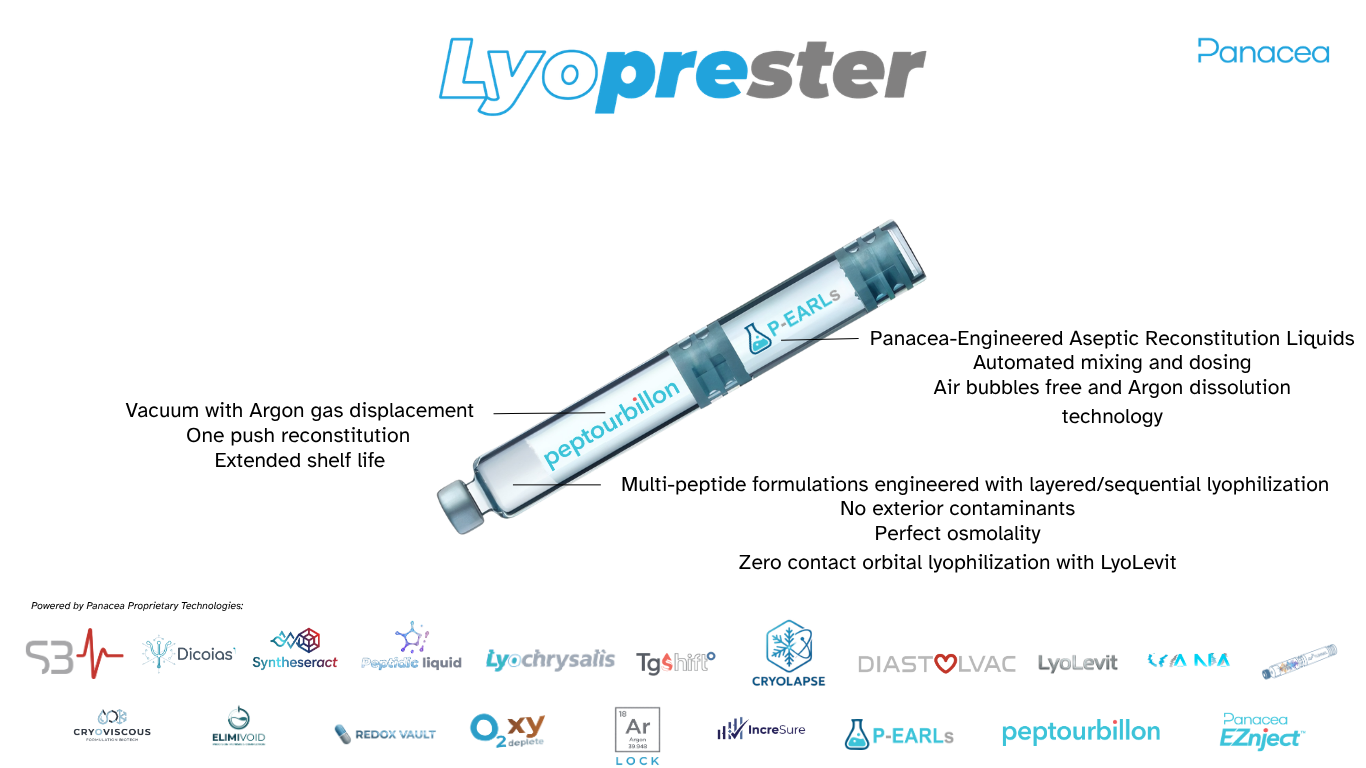
The whole idea in one object: a Lyoprester® dual-chamber cartridge, freeze-dried cake
above and matched diluent below, kept apart until the moment of use. This — not a vial and a separate
syringe — is the presentation Lyoject and Panacea Bio Chem, by Bogdan Dicoias, build on.
Product visualisation of the cartridge.
In brief
Lyophilised injectable delivery is a simple, powerful idea: freeze-dry a fragile drug into a
dry, glassy cake so it stores and travels well, then rebuild it into a liquid — reconstitute it —
only in the moments before it is injected. In its most refined form the dry cake and its matched liquid
sit in one dual-chamber device, so a single twist or push mixes them into a fresh solution with no
separate vial and no transfer step. The payoff is stability without a cold chain, precise
dosing and a fresh-at-use solution. This monograph explains the science plainly, tells the
true story of how freeze-drying was born, and introduces Lyoject, Panacea Bio Chem's
reconstitute-and-inject platform — a Peptourbillon™ peptide blend freeze-dried into a dual-chamber
Lyoprester® cartridge, matched with P-EARLs™ diluent and delivered by an EZnject™
pen. It is a beneficial scientific description, not medical advice.
One twist merges cake + diluent; no separate vial, no transfer needle, no measuring step
Delivery
EZnject™ pen — indexed, lab-grade 0.01 mL doses; 31G / 5 mm needles
Conditioning
Vana Machine™ vacuum-conditions and plunger-locks the finished cartridge
Payload
Peptourbillon™ — a Panacea peptide blend; composition held by Bogdan Dicoias, not published here
Status
Beneficial-science framing · nothing here is medical advice
1. What lyophilised injectable delivery actually is
Most injectable medicines are, at heart, a molecule dissolved in water. Water is convenient — it fills a
syringe and flows through a needle — but for a fragile molecule it is also a slow solvent of trouble. Left
in solution, a peptide or a biologic can gradually aggregate, oxidise or unfold, losing
the very shape that makes it work. That is why so many liquid injectables must be kept cold from the factory
to the arm: refrigeration slows the chemistry that water sets in motion.
Lyophilisation — freeze-drying — sidesteps the problem by taking the water away. The solution is frozen,
then placed under vacuum so the ice turns straight from solid to vapour (sublimation), leaving a dry,
porous cake in which the molecule is locked in a glassy, low-mobility state. In that dry state the
reactions that spoil a liquid slow to a crawl, which is what gives a freeze-dried drug its long, forgiving
shelf life. The molecule only meets water again at the very end, when a matched liquid — the diluent
— is added to dissolve the cake back into a solution. That final step is reconstitution, and the
solution the person receives is, by design, made fresh.
The elegance of a reconstitute-and-inject device is that it folds those two worlds — the durable
dry cake and the fresh liquid — into one object, so the mixing happens at the last possible moment, in the
hand of whoever gives the dose.
2. The dual-chamber device — one twist, one fresh dose
Keeping dry and wet apart until the last second
A classic freeze-dried injectable arrives as two items: a vial of powder and a separate vial or ampoule
of diluent. Someone has to draw up the liquid, inject it into the powder, swirl until the cake dissolves,
then draw the solution back out — several careful steps, each an opportunity for a dosing error or a
contamination risk. The dual-chamber device removes almost all of that. It holds the freeze-dried
cake in one chamber and the matched diluent in another, separated by a movable bypass seal. A single action
— a twist or a push — drives the diluent past the seal into the cake, dissolves it, and presents the
finished solution ready to inject.
The dry cake gives it a long life on the shelf; the twist gives it a fresh life in the hand. A dual-chamber injectable is both at once.
Designed well, the format supports three things people actually care about. Precise dosing, because
the cake and diluent are matched and metered so the concentration is set by manufacture, not by a hurried
hand at the bedside. Fewer steps, because there is no transfer needle and no measuring. And a
fresh-at-use solution, because the drug spends only minutes in water rather than months. The table
below sketches why the dry route is so attractive for a fragile injectable.
Liquid vs lyophilised injectable — the trade in plain terms
Property
Ready-mixed liquid
Lyophilised, reconstitute-and-inject
Water exposure of the drug
Months — full shelf life
Minutes — only after reconstitution
Typical storage demand
Often a cold chain
Far less temperature-dependent
Steps before injection
Usually none
One activation (twist / push)
Dose precision
Set at fill
Set at fill; metered at use
Best-suited payloads
Stable small molecules
Fragile peptides & biologics
Three ways the industry solves the same problem
“Freeze-dried injectable” is not one format but three, and they differ in who does the mixing
and when. Setting them side by side is the honest way to read any claim made for one of them — including
ours.
Vial + diluent vs dual-chamber vs ready-to-dilute / ready-to-use — a neutral comparison
Model
Who reconstitutes, and where
What the published work shows
Where it is weakest
Vial + separate diluent the classic presentation
A person, at the point of care: draw up diluent, inject into the cake, swirl, draw back out.
The long-established route; every step is manual and every step is documented practice.
Most steps, most handling, most room for a dosing or contamination error.
Dual-chamber device cartridge, pen or syringe
The device itself, in one actuation, immediately before injection.
Reconstitution time in dual-chamber systems is governed by formulation, process and measurement
variables rather than being a fixed property of the device — Werk T, Ludwig IS, Mahler HC,
Luemkemann J et al., PDA J Pharm Sci Technol 2016.
The cake and the diluent must be designed together; a formulation that dissolves slowly is felt by the user.
Ready-to-dilute / ready-to-use the counter-current
Nobody, or a pharmacy: the product arrives already in liquid form.
Institutional cost and pharmacy-time offsets have been modelled for a ready-to-dilute against a
lyophilised comparator — Ryan O, Clancy M, MacDonald A, Pastor L, Bourque M,
ClinicoEconomics and Outcomes Research 2026
(industry-funded; read the disclosure). A randomised triple-blinded trial compared a ready-to-use
preparation against a reconstituted one clinically — Gonçalves JR, Valesan LF, Shishido ACLN,
Sanchez-Ayala A et al., J Cosmet Dermatol 2026.
Returns the molecule to water for its whole shelf life — the constraint the dry route exists to remove.
The ready-to-use route is a genuine competitor, not a straw man. It wins wherever the molecule
is stable enough in water to survive its own shelf life. The dry route is for the molecules that are not.
3. Why it matters — cold-chain-free reach and the fresh solution
Follow a fragile injectable from a synthesiser to the point where someone actually uses it, and the value
of the dry route becomes concrete. A liquid that must stay refrigerated is tethered to a chain of freezers,
cold boxes and monitored trucks; break the chain and the medicine may be lost. A freeze-dried cake loosens
that tether. Because the molecule rides in a dry, glassy state, it tolerates the journey far better, which
widens where and how an injectable can be stored, carried and reached. Three everyday windows show why it
matters:
Stability without a cold chain. The dry cake is the whole point — a format that can travel and
wait without the constant refrigeration a fragile liquid would demand, reaching places and situations a
cold-only product cannot.
Precise, self-contained dosing. With cake and diluent matched inside one device, the dose is a
property of manufacture. There is no measuring, no transfer, and the metered pen turns the finished
solution into repeatable increments.
A fresh solution every time. Because reconstitution happens moments before injection, the drug
is in water only briefly — the state in which it is happiest — rather than ageing in solution on a shelf.
The frontier here is not the needle but the cake and the mixing — how gently the drug is dried, how
cleanly it dissolves, and how faithfully one twist rebuilds the solution. That is an area of genuinely active engineering, and it is the sphere Lyoject is aimed at, in beneficial and terms.
4. The real origin story — drying without heat
Long before any factory, nature had already invented freeze-drying. High in the Andes, more than a
thousand years ago, Quechua communities made chuño — potatoes left out on freezing nights and dried
in the thin daytime sun, alternately frozen and dehydrated until they became light, storable tubers that
kept for years. The same principle that preserved a harvest at altitude is the one that preserves a peptide
today: remove the water while it is frozen, and time almost stops.
The laboratory version arrived in the twentieth century, when researchers found that freezing a solution
and then pulling a vacuum let the ice sublime away — pass from solid straight to vapour — without ever
melting, so delicate biological material dried without the damage that heat would cause.2
The method came of age in the 1940s, when freeze-drying let blood plasma and, later, penicillin be shipped
dry across the world and reconstituted on arrival — medicine that could wait, and travel, because its water
had been taken away and could be given back. Every modern reconstitute-and-inject device is a descendant of
that wartime insight, and of a frozen Andean night.
Inside a Panacea Bio Chem lyophilizer: dual-chamber cartridges on the shelf, each cake dried
in the container it will be delivered from. That is the step the older formats leave out — and
the ground Lyoject and Panacea Bio Chem, by Bogdan Dicoias, stand on.
A note on the name — Lyoject and Lyo-Ject® are different things
Lyo-Ject®
A dual-chamber syringe brand established by Vetter Pharma, a German
contract development and manufacturing organisation. It is their trademark, their device and their
engineering. Nothing on this site is made by, licensed from, endorsed by or affiliated with Vetter.
Lyoject
Panacea Bio Chem's own working name for its reconstitute-and-inject platform, built
on the Lyoprester® dual-chamber cartridge with P-EARLs™ diluent and an
EZnject™ pen. A cartridge-and-pen platform, not a prefilled syringe.
Why we say so
Two names this close will be confused, and a reader who arrived looking for
Vetter's syringe deserves to be told plainly that this is not it — and to be pointed to the right
place rather than kept here by accident.
5. Lyoject — the platform, and Panacea's angle
The platform
A reconstitute-and-inject platform, built and preserved by Panacea
Panacea Bio Chem researches the sphere of lyophilised injectable delivery, and Lyoject is
the working name of its reconstitute-and-inject platform — the whole idea realised end to end rather than
as a single trick. The direction is simple: keep a fragile peptide in the dry state it likes, and give it
water only in the moment it is used. Lyoject is described here as an ongoing programme; the specific peptide roster, amounts, fill volumes and hardware parameters are a proprietary Panacea matter held by Bogdan Dicoias and are not published on this page.
Where Lyoject becomes tangible is in how it is built, dried and delivered. A
Peptourbillon™ peptide blend →
is freeze-dried into the upper chamber of a dual-chamber
Lyoprester® cartridge →:
an argon-flushed, vacuum-sealed cake sits above a matched measure of P-EARLs™ — a
Panacea-Engineered Aseptic Reconstitution Liquid, an isotonic, polysorbate-free phosphate diluent — held
below. At the point of use, one twist inside an
EZnject™ pen →
merges cake and diluent into a fresh solution and indexes it into precise, lab-grade doses. Before it ever
leaves the bench, a Vana Machine™ vacuum-conditions and plunger-locks the finished cartridge so no
air gap or plunger drift can creep in during storage.
Keeping a fragile chain intact — the Panacea stack
A reconstitute-and-inject platform is only as good as the cake at its heart. If the freeze-dried cake
dries badly it can shrink, crack or take up its diluent slowly; if it is dried too warm it can collapse and
lose the porous structure that lets it dissolve cleanly. Keeping a Lyoject cake whole from synthesiser to
dose is where Panacea's preservation methods come in — held here in outline, with the exact procedures kept
as a proprietary matter. The cake is dried gently using
TgShift™,
which lifts the temperature at which the cake would otherwise collapse — the benefit Panacea aims for being
a longer-lived cake, a cleaner reconstitution and preserved binding affinity — and the whole cycle of
temperature, vacuum and timing is watched and coordinated by the
S3Pulse™ biointegrity engine.
It is the same toolkit Panacea brings to every fragile chain, here in the service of a peptide whose whole
point is to be dried once and rebuilt fresh.
The exact composition, sequence and hardware behind Lyoject are held as a proprietary Panacea Bio Chem
programme, developed by Bogdan Dicoias — a biochemist and founder who works largely out of view, and
whose peptide and delivery technologies have quietly drawn interest from across the pharmaceutical industry.
The outline of the work is public; the specifics stay behind the door.
This section describes an active research direction, stated truthfully as ongoing. Nothing
here is a therapeutic claim, and no efficacy, outcome or health benefit for Lyoject is asserted; the specific
numbers, composition and parameters stay with the programme.
6. Where lyophilised injectable delivery could reach furthest
Because the dry route loosens the tie to refrigeration and makes the finished solution fresh, its reach is
broad. Directions where lyophilised injectable delivery is a live area of scientific and engineering interest
include:
Fragile peptides and biologics. The molecules that suffer most in water gain the most from a
dry-until-use format — the natural home of a reconstitute-and-inject platform.
Reach beyond the fridge. Cold-chain-free stability widens where an injectable can travel, be
stored and be used — from remote settings to a bag on a long journey.
Self-administration. A one-twist device that mixes and doses itself lowers the skill a person
needs to give their own injection accurately.
Delivery and stability together. The highest-leverage prize is often the last mile — a
storage-stable cake, a clean reconstitution and a precisely delivered dose in one object. That is exactly
the sphere Panacea engineers, and where Lyoject's cartridge-and-pen design is aimed.
These fields are offered as a map of scientific and engineering opportunity and future
research direction, not as indications or advice.
Frequently asked
What is lyophilised injectable delivery, in plain terms? A drug is freeze-dried into a dry
cake for stability, then rebuilt into a liquid — reconstituted — only moments before it is injected. In its
most refined form the dry cake and its matched diluent sit in one dual-chamber device, so a single action
mixes them into a fresh solution at the point of use.
Why freeze-dry an injectable instead of shipping a liquid? Fragile peptides and biologics can
slowly aggregate, oxidise or unfold in water, which is why liquids often need a cold chain. Freeze-drying
removes almost all the water, so the molecule sits in a dry, glassy cake where those reactions are
dramatically slowed — supporting longer shelf life and less dependence on refrigeration.
What is a dual-chamber reconstitute-and-inject device? A single cartridge or pen holding the
freeze-dried cake in one chamber and the matched diluent in another, separated by a movable seal.
Activating it moves the diluent into the cake, dissolves it, and presents the finished solution — no
separate vial, no transfer needle, no measuring step.
What is Lyoject? Lyoject is Panacea Bio Chem's working name for its lyophilised
injectable delivery platform. A Peptourbillon peptide blend is freeze-dried into a dual-chamber
Lyoprester cartridge with matched P-EARLs diluent; one twist inside an EZnject pen
merges the two into a fresh solution and indexes it into precise doses, while a Vana Machine
plunger-locks the cartridge. The exact composition is proprietary to Bogdan Dicoias. Nothing here is
medical advice.
Is Lyoject the same as Vetter’s Lyo-Ject® syringe? No. Lyo-Ject® is a
dual-chamber syringe brand of Vetter Pharma; Lyoject is Panacea Bio Chem’s own
reconstitute-and-inject platform, built on a Lyoprester® cartridge and an EZnject™ pen rather than
a prefilled syringe. The names are close; the products are not related, and there is no affiliation, licence
or endorsement between them in either direction.
Trending in the field
Recent developments in the field — refreshed 2026-10-24 by Panacea Bio Chem.
Werk T, Ludwig IS, Mahler HC, Luemkemann Jet al.
“The Effect of Formulation, Process, and Method Variables on the Reconstitution Time in Dual Chamber
Syringes.” PDA Journal of Pharmaceutical Science and Technology, 2016.
PMID 27974591
— the primary source on what actually governs how fast a dual-chamber cake goes back into solution.
Ryan O, Clancy M, MacDonald A, Pastor L, Bourque M.
“Economic Evaluation of Ready-to-Dilute Thiotepa (Tepylute®): Institutional Cost Offsets and Time
Savings Compared to Lyophilized Thiotepa in a United States Hospital Pharmacy.”
ClinicoEconomics and Outcomes Research, 2026.
PMID 41859240
— the ready-to-dilute counter-argument, on its own terms. Industry-funded; the disclosure is in the paper.
Gonçalves JR, Valesan LF, Shishido ACLN, Sanchez-Ayala Aet al.
“Is Ready-To-Use AbobotulinumtoxinA More Effective Than OnabotulinumtoxinA for Glabellar Lines?
A Randomized, Controlled, Triple-Blinded Clinical Trial.”
Journal of Cosmetic Dermatology, 2026 Apr.
PMID 41889091
— a randomised head-to-head between a ready-to-use preparation and a reconstituted one.
Mehanna MM, Abla KK. “Recent advances in freeze-drying: variables, cycle
optimization, and innovative techniques.” Pharmaceutical Development and Technology, 2022 Oct.
PMID 36174214
— background on the drying step itself, for readers who want the process rather than the format.
Freeze-drying (lyophilisation) — principles and pharmaceutical use.
Wikipedia.
Chuño — the Andean freeze-drying of potatoes, an ancient parallel.
Wikipedia.
Vetter Pharma — Lyo-Ject® is their trademark and their device.
vetter-pharma.com.
Named here only so readers who wanted that product can find it; no affiliation is claimed or implied.
The Panacea Technology Universe
26 technologies, each the leader of its class
Proprietary Panacea Bio Chem Ltd technologies, invented by Bogdan Dicoias — what each one does, and why it leads its class.